If you treat seasonal content like an annual surprise party—fun in theory but chaotic in practice—you’re doing it wrong. I’ve learned (the hard way, with several “why-is-this-not-ranking?” panic sessions) that seasonal wins are less about spontaneity and more about timing, systems, and a little bit of SEO elbow grease. ⏱️ 12-min read
This guide walks you through a repeatable, WordPress-friendly plan: how to find the exact moments your audience cares, schedule them without last-minute chaos, write posts that convert, and measure what actually moves the needle. Expect practical templates, tool suggestions, and one or two sarcastic analogies because yes, content calendars deserve to be both efficient and not soul-crushing.
Pinpoint Seasonal Opportunities in Your Niche
Seasonal planning starts with observation and data, not guessing. Think of it like birdwatching for search intent: you watch the patterns, note the migrations, and then show up with binoculars and a blog post. Start with obvious calendar anchors—Black Friday, Cyber Monday, Christmas, Mother’s Day—then add niche-specific moments: back-to-school for education-focused sites, tax season for finance blogs, product launch cycles if you're in tech or beauty. I like to build a simple matrix: event → buyer need → content format → target publish window.
Inspect last year’s monthly traffic (yes, the boring spreadsheets matter). If November exploded but you had no gift guide, that’s a gap you can fill. Survey readers, skim comments and DMs, and ask your sales or product team what customers ask about during peak periods. That qualitative intel often reveals the real intent behind spikes—people searching for "best gifts for dog lovers" are a different crowd than "cute dog bandanas DIY." One is ready to buy, the other wants a project.
Use Google Trends to validate timing and rising queries (it’s free and annoyingly useful). Look for patterns where interest begins to climb 4–8 weeks before your peak—this is your content prep window. Map each seasonal spike to specific content goals: awareness (timely listicles), conversion (gift guides and product roundups), or retention (how-to maintenance guides). Treat these as pillars and build clusters around them so your seasonal content isn’t a flurry of single posts but a coordinated campaign with real SEO weight—kind of like a choir instead of a guy yelling into a megaphone.
Build a Seasonal Content Calendar in WordPress
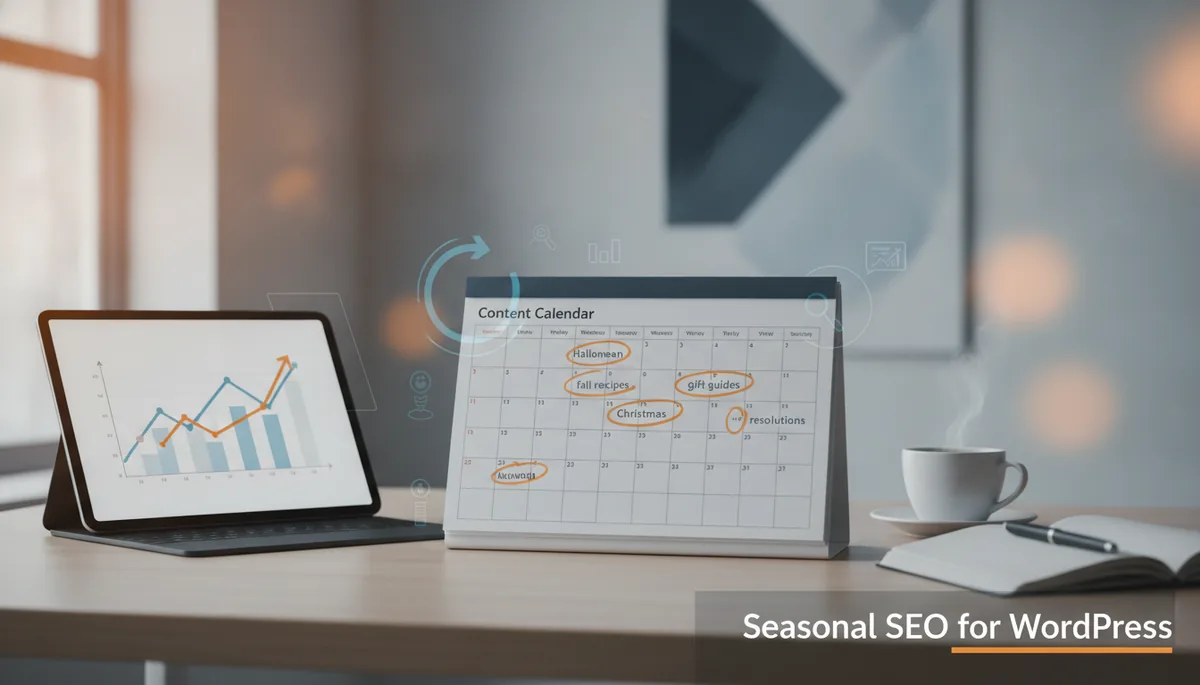
Your calendar is the backbone; without it, seasonal content becomes frantic last-minute blogging and that’s a cycle of shame and poor rankings. I use an editorial backbone in WordPress or a connected tool (Trello or Asana works if your team likes cards and guilt reminders). Plugins like PublishPress or Editorial Calendar integrate directly into WordPress and keep everything visible—no more “I thought someone else was doing that” theater.
Start by creating slots that mirror your publishing cadence. If you publish twice a week, leave two seasonal slots per month plus a buffer for refreshes. Then map topic → publish date → content type → owner. A one-line example on a calendar might read: "Nov 10 – Holiday Gift Guide (roundup) – Sam – Publish & Pinterest." That tiny clarity saves countless Slack messages and passive-aggressive calendar invites.
- Define workflow stages: Idea → Draft → Review → SEO check → Schedule → Publish. Attach simple SLAs (48 hrs for draft, 24 hrs for review) so the relay baton doesn’t get dropped.
- Visualize bottlenecks: color-code stages—if image design takes longer, give it an earlier deadline.
- Automate reminders: set email or in-app notifications for metadata, images, and schema checks.
For teams, connect your WordPress calendar to shared tools. For solo bloggers, use a template in WordPress or Google Sheets—whatever keeps you honest. If you’re scaling, consider an automation layer (Trafficontent and similar tools can schedule posts and push content to social platforms), but don’t skip the manual check—automation is a helpful assistant, not a creative director. Think of your calendar as good hygiene: boring to plan, extremely satisfying when things don’t smell like chaos.
Research Seasonal Keywords and Topics
Keyword research for seasonal content is its own little science experiment: look for terms that spike predictably, tag their intent, and publish right before interest accelerates. Use tools like Google Trends to spot interest over time, and pair it with Semrush or Ahrefs for volume and competition insights. I keep a master sheet of 20–40 keywords per season—mix of short and long tail—and I tag each with intent: informational, transactional, or navigational.
Study trend graphs to find the lead time. If "best running shoes for winter" starts climbing in September, aim to publish in late August so Google can index and rank your post before the sprint starts. Pull related queries and "people also ask" boxes for phrase ideas and FAQ content—those are gold for earning featured snippets. Long-tail, intent-heavy phrases like "best Christmas gifts under $50 for college students" often convert better than the short, high-volume head terms; they tell you exactly what the searcher wants.
- Export your keyword list from your tool of choice and remove duplicates.
- Group keywords into themes (gifts, how-tos, roundups, local events) and map each group to a content format.
- Assign a priority score: search volume × intent × seasonal window alignment ÷ competition difficulty.
This is where strategy beats hustle. Rather than chasing every rising query, prioritize topics you can realistically rank for and that match your audience’s buying cycle. If you're smaller, target narrower long-tail phrases that scream buying intent; if you're established, aim for larger pillar pages and clusters. And yes, sometimes the best keyword is the one nobody else thought to write after—like a lonely cottage in the woods that Google treats like a hidden treasure for six months. Link: Google Trends (https://trends.google.com).
Craft Seasonal Post Formats That Convert
Format matters. A seasonal post that reads like an instruction manual will perform differently from one that's a conversion-focused roundup. I divide formats by intent: transactional content gets roundups and product lists; informational needs how-to guides, checklists, and printable templates; local interest suits event roundups with maps and directions. Pick the format that answers the user’s question fastest—people in holiday mode don’t want a novel, they want a solution.
Gift guides and roundups: Keep them tight—5–7 curated picks grouped by price or theme. Include quick blurbs, pros/cons, and an obvious CTA (Shop the guide, Buy now). Use consistent product names, short specs, and clear affiliate disclosures. Add comparison tables for quick scanning. Think of it as speed-dating for products: quick facts, no small talk.
How-to guides and checklists: Break steps into scannable sections, include a printable checklist or downloadable template, and use how-to schema if you can. A step-by-step format increases dwell time and is more likely to earn rich results. For example, an "Outdoor Lighting Reset for Spring" piece could include a materials list, step-by-step photos, a downloadable wiring diagram, and a “call your electrician” safety note—because we don’t need any DIY disaster stories here.
Internal linking and content upgrades: Each seasonal post should link to evergreen and related seasonal content. Offer a content upgrade—email checklist, printable planner, or discount code—to capture leads and lengthen engagement. Add CTAs that match intent: “Compare options,” “Download the checklist,” “Shop now.” My rule of thumb: one conversion touch per post, one soft CTA for more info, and one hard CTA for purchase-oriented pages. Use images and alt text strategically—descriptive and helpful, not keyword vomit.
SEO and Technical Prep for Seasonal Posts
Seasonal posts are time-sensitive, so the SEO and technical box must be checked early. In WordPress, that means titles under ~60 characters, meta descriptions near 150–160 characters, and the primary keyword close to the front. Use H2s and H3s for scannability. Compress images, lazy-load where appropriate, and test mobile layout because most people will read your list on a phone while standing in a store aisle trying to decide between “cute” and “functional.”
- Structured data: Add JSON-LD for Article, Product, or Event where relevant. Schema helps search engines display dates, prices, and availability directly in results. Plugins like Yoast or Rank Math simplify this for WordPress—use them unless you enjoy manual JSON debugging at 2 a.m. (link: Yoast https://yoast.com).
- Performance: Aim for sub-3s load times on mobile. Use a CDN, optimize images, and limit plugin bloat—WordPress sites pile on plugins like cats pile on couches.
- Open Graph and social previews: Ensure social cards look good. Pinterest especially drives seasonal discovery; make sure your OG image is tall and Pinterest-friendly.
Also plan your internal linking before publishing. Create a seasonal hub page that links to every individual piece and to evergreen content; this concentrates authority and helps your new post get crawled faster. If you use automation tools like Trafficontent, they can inject FAQ schema and push your content to social platforms automatically—handy, but double-check the schema output. Small technical fixes (alt text, structured data, fast hosting) often produce bigger results than rewriting a headline for the tenth time. I say this as someone who has rewritten headlines in a meeting thinking it would solve everything—spoiler: it didn’t.
Publish, Promote, and Repurpose Seasonal Content
Publishing is only step one—promotion and repurposing do the heavy lifting. Schedule your posts to go live during the window you identified in keyword research. Then promote across channels that map to your audience: Pinterest for visual gift guides, X (Twitter) for timely updates, LinkedIn for professional seasonal topics, and email newsletters for your most loyal readers. I treat the publish moment like launching a mini-campaign: post, pin, and email within the first 48 hours to capture early clicks and engagement signals.
Repurpose relentlessly. Turn a long gift guide into 10 Pinterest pins, a few Instagram stories, a LinkedIn carousel, and a short email sequence. Convert how-to guides into downloadable checklists and short explainer videos. Repurposing stretches the life of a single piece of content across channels and increases your chances of being found when someone searches. It’s like turning a loaf of bread into breadcrumbs, toast, and croutons—useful and slightly greedy.
- UTM tracking: Add UTM parameters for every promotion so you can measure what drives traffic and conversions.
- Automation: Tools (Trafficontent included) can schedule posts and distribute automatically. Use automation for distribution but not for creative judgment—if your social caption needs a human voice, give it one.
- Influencer/local partnerships: For event roundups, ask local vendors to share your post and tag you. For product guides, coordinate with brands for exclusive offers.
Finally, have a refresh plan. Two to three weeks before a peak season, refresh your top-performing posts: update prices, add new products, and tweak CTAs. That gives Google reason to re-crawl and often improves rankings just when you need them most. Treat content promotion like tending a garden—you don’t plant and forget; you water, prune, and occasionally bribe neighbors to admire it.
Measure, Learn, and Iterate on Seasonal Campaigns
Seasonal content is a cycle, not a one-time sprint. Track KPIs and learn for the next iteration. I rely on GA4 for traffic and engagement, Google Search Console for query and ranking changes, and my keyword tool for position tracking. Set concrete targets for each season: organic visits, CTR, conversion rate, and revenue per post if you’re monetizing. Without numbers, you’re just making content and calling it strategy—like wearing a suit to a Zoom meeting and forgetting to turn on your camera.
Set up alerts for sudden traffic changes so you can act quickly—either to amplify a winning post or to troubleshoot a drop. Run quick A/B tests: headlines, meta descriptions, and hero images are good places to test for CTR lift. Compare dwell time and bounce rates across formats to see what keeps readers reading. If a roundup has high clicks but low time on page, your readers might be scanning and leaving—consider richer descriptions or comparison tables.
- Archive vs refresh: If a post is stale, decide to archive (remove) or refresh with updated data and dates. Minor refreshes often yield big ranking boosts for seasonal posts.
- Repurpose top performers: Convert your best posts into email sequences, paid ads, or downloadable assets.
- Document learnings: Keep a seasonal playbook with what worked, what failed, and sample CTAs/titles that lifted the most.
The goal is compound improvement: each season should be a bit smarter than the last. Treat every campaign like an experiment: measure, log results, and apply lessons. If this sounds like science class, that’s because SEO is part art and part lab work. Reference: Google Search Console overview (https://search.google.com/search-console).
Starter WordPress Setup for Seasonal Success
If you’re just starting, pick a lean WordPress setup that lets you move fast without breaking things. For hosting, WordPress.org on a managed host gives the most flexibility; WordPress.com is fine for simpler sites, but you’ll hit plugin and monetization limits faster than you can say “affiliate link.” Choose a clean, mobile-first theme—Astra, GeneratePress, or the official WordPress themes are good starting points. Don’t overdo the fancy features; speed and clarity beat a thousand bells and whistles.
Plugins: keep the list short and intentional. Essentials include an SEO plugin (Yoast or Rank Math), a caching plugin (WP Rocket or a host-provided option), an image optimizer (ShortPixel or Imagify), and a calendar/editorial plugin (PublishPress or Editorial Calendar). Add schema support if your SEO plugin doesn’t fully cover it. Avoid plugin clutter; each extra plugin is like adopting another roommate—you’ll have to feed it and clean up after it.
- Install a mobile-first theme and set up basic pages (About, Contact, Privacy, Seasonal Hub)
- Configure SEO plugin: site title, meta defaults, XML sitemaps
- Set up analytics and Search Console, and verify property
- Create a seasonal content calendar in a plugin or Google Sheet with publish windows and owners
For a solo blogger, start with a simple checklist: pick hosting, install WordPress, choose a theme, add the three core plugins, and create your first seasonal hub page. For teams, define roles early—who writes, who approves, who promotes—and set SLAs so the content machine runs smoothly. If you want a path to scale, plan for a CMS structure: categories for seasons, tags for themes, and hub pages that aggregate seasonal content. WordPress grows with you if you plan sensibly—like a plant that you don’t overwater.
Reference: WordPress.org (https://wordpress.org/)
Next step: pick one upcoming seasonal event from your niche, map a content idea to it, schedule it in your calendar today, and set a reminder to refresh it next year. That small habit is the beginning of compounding seasonal traffic.