The holiday season can turn a steady Shopify store into a high-velocity sales engine — if your content and timing are ready. Seasonal promotions create windows of intense buyer intent: shoppers hunt for gifts, fast shipping, and curated suggestions. But that upside only arrives if you execute consistently across product pages, blog posts, email, and social media. Missed deadlines, inconsistent messaging, or last-minute copy errors are costly during those peak weeks. ⏱️ 10-min read
This guide walks Shopify owners and small e-commerce teams through a pragmatic workflow using Trafficontent to plan, generate, publish, and measure holiday content. You’ll find concrete steps for building a holiday calendar, automating blog and product copy, scheduling social posts, sharpening product page SEO for gift-driven searches, and measuring results so each season becomes easier and more profitable than the last.
The Power of Seasonal Promotions for Shopify Stores
Seasonal campaigns are more than a marketing calendar checkbox — they are a powerful lever for both short-term revenue and long-term customer acquisition. During holiday windows shoppers are actively searching for ideas and deals; that heightened intent converts browsers into buyers more readily than most other times of year. Limited-time offers, shipping cutoffs, and holiday bundles create urgency and reduce decision friction, which lifts conversion rates and average order value when executed well.
Beyond immediate sales, seasonal campaigns are a brand-building opportunity. Well-timed gift guides, curated collections, and holiday storytelling introduce your products to new audiences and create shareable moments that extend reach. For many stores the holiday season becomes the largest source of new customer acquisition — and those customers, if properly onboarded, can become repeat buyers through post-holiday welcome and retention flows.
Finally, holidays compress buying behavior into predictable peaks, which makes measurement straightforward. You can test creative, pricing, and bundles during Black Friday/Cyber Monday or the run-up to Christmas, then translate what worked into evergreen approaches for other promotional windows. The key is predictable, coordinated content that meets shoppers where they are searching — and that’s where automation pays dividends.
Common Holiday Campaign Hurdles for Shopify Owners
Holiday planning often runs into the same practical obstacles: tight timelines, content overload, staffing gaps, and fierce competition. Teams are asked to produce gift guides, landing pages, promotional banners, product description refreshes, and a steady stream of social posts — all on compressed schedules. That pressure amplifies the risk of typos, inconsistent offers, or missed SEO opportunities that can reduce visibility right when it matters most.
Consistency across channels is another frequent problem. Email, blog, product pages, and paid ads each have their own cadence and format, which makes it easy for promo codes, dates, or CTAs to drift out of sync. Conflicting messages erode customer trust and introduce friction at checkout. Small teams suffer more: holiday PTOs, limited headcount, and manual handoffs create bottlenecks and errors just when uptime is critical.
Finally, the marketplace is loud during holiday seasons. Generic promotions fade quickly in crowded inboxes and feeds. To stand out you need clear promotional angles—bundles, personalization, scarcity-based messaging—and the capacity to execute them at scale. That’s exactly where automation and a single source of truth for content — from blog to product to social — shift the odds in your favor.
Trafficontent's Role in Streamlining Your Shopify Holiday Strategy
Trafficontent is designed to convert a holiday marketing plan into repeatable, coordinated content that publishes on schedule. Its most valuable contribution is turning strategy into scalable execution: concept to publish in a single workflow rather than a string of manual tasks. For holiday campaigns that means predictable timelines, fewer approval bottlenecks, and consistent messaging across all channels.
Key features that matter for Shopify owners include AI-assisted content generation for blogs, product descriptions, and social captions; an SEO workflow that suggests holiday-specific keywords and placements; and a Smart Scheduler that orchestrates multi-channel publishing. Trafficontent also enforces style guidelines and terminology so product pages, blog posts, and social captions read as a cohesive brand voice — even when multiple people contribute.
Perhaps most importantly, Trafficontent integrates directly with Shopify. You can push content to blogs, product descriptions, and collection pages without manual copy-and-paste. That Shopify-ready deployment removes a common source of error and saves hours during peak weeks. When you combine automated content generation, scheduled publishing, and a single calendar view, you replace last-minute scrambling with a calm, repeatable rhythm.
Crafting Your Holiday Content Calendar with Trafficontent
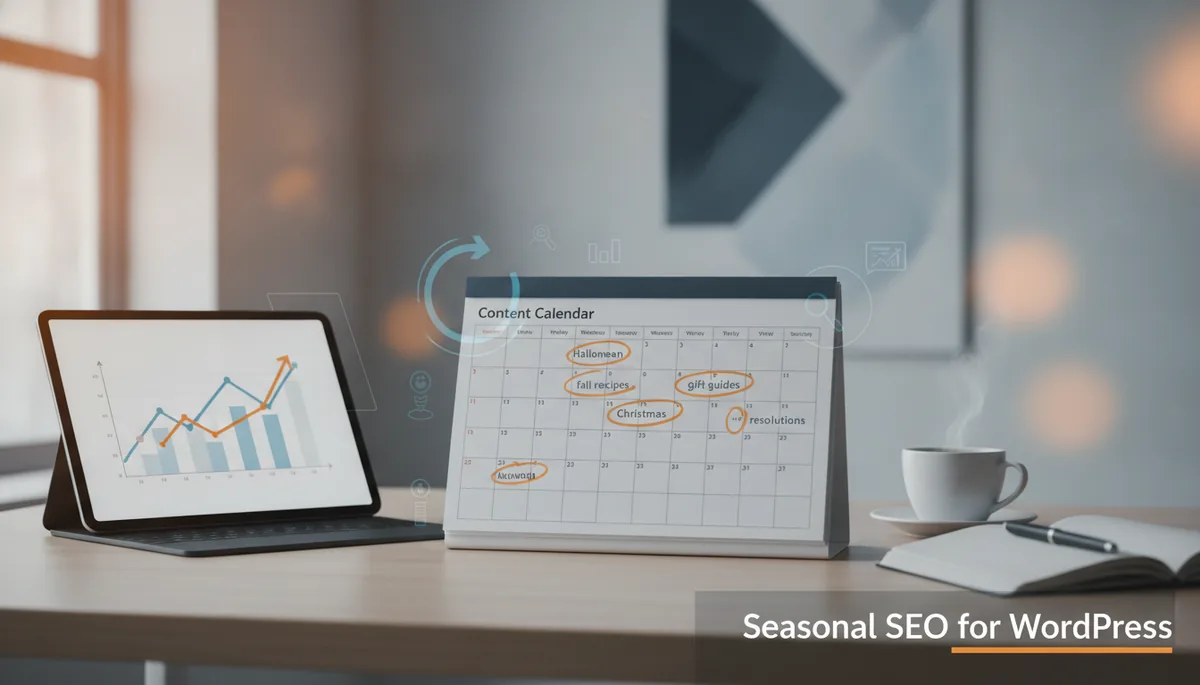
A reliable holiday campaign starts with a calendar that maps dates to content and inventory realities. Begin by listing key shopping days—Black Friday, Cyber Monday, Small Business Saturday, the last recommended shipping date for your primary markets, and any niche events relevant to your products. With Trafficontent, place these dates on a shared calendar and align them with inventory windows and logistics cutoffs so you don’t promote items you can’t deliver.
Next, brainstorm themes and content types for each window. For example, the week before Black Friday might focus on “early gifts for busy parents,” while Cyber Monday highlights “tech stocking stuffers.” For each theme, assign 2–3 content formats: a blog gift guide, three product page updates, two email sequences, and a sequence of social posts. Trafficontent can help automate this step by generating theme suggestions and pairing them with keyword-driven content briefs.
Create reusable templates in Trafficontent for blog posts, product descriptions, and social variants. Templates speed production and keep voice consistent. Use them to outline typical blog structures (intro, top picks, product calls-to-action, related collections), product description formats (lead benefit, features, social proof, urgency), and social caption patterns (hook, product link, CTA, hashtag set). Finally, pre-schedule content so posts, product copy, and emails queue up weeks ahead; this reduces last-minute edits and keeps campaigns aligned across channels.
Automating Blog Posts and Product Page Content for the Holidays
Trafficontent’s automation shines when you need a steady stream of seasonal content without endless manual work. For blogs, generate SEO-optimized gift guides and how-to articles that funnel readers to product pages. Examples include “Top 10 Gifts for New Homeowners” or “How to Build a Cozy Holiday Table.” These posts not only attract organic visitors but also provide internal links to key product pages, bolstering on-site conversions.
On product pages, Trafficontent can auto-update descriptions with holiday language and long-tail keywords that shoppers use during the season. Add phrases like “limited holiday edition,” “gift-ready,” and shipping cutoffs. Create short urgency lines — “Order by Dec 18 for guaranteed delivery” — and feature them near the add-to-cart button. The platform can generate multiple description variants so you can A/B test which tone (personal, practical, luxury) drives higher conversion for different SKUs.
Use Trafficontent to tailor gift guides to customer segments: budget shoppers, premium gift buyers, last-minute gifters, or corporate bulk buyers. Each guide links to curated collections on Shopify, with product pages reflecting the guide’s messaging. This segmentation increases relevance: a boutique that built segmented guides and sent matching email flows saw a meaningful bump in conversion because recommendations matched what customers were most likely to buy.
Maximizing Reach with Automated Social Media Scheduling
Social media is where shoppers discover gift ideas and validate purchases. Trafficontent makes it practical to maintain a steady, coordinated presence through holiday peaks by batching and scheduling posts in advance. Start by creating a library of holiday posts and image variants tied to campaign themes. For each theme produce 5–7 caption variants and 3–4 visual options, then schedule them for optimal times using Trafficontent’s Smart Scheduler.
The Smart Scheduler takes into account platform-specific peak times and time zones, so your promotions reach customers when they’re most active. Stagger posts across channels—Facebook, Instagram, X, and Pinterest—to avoid oversaturation while keeping visibility high. Use template-driven variants to tweak headlines, CTAs, and imagery for different audiences or regions without losing your brand voice.
Trafficontent also supports a direct flow from social posts to Shopify products and blog content. Link social captions to the exact collection or product page so a shopper who clicks lands on a page optimized for conversion. For example, a story promoting a holiday bundle can link to a product page that already features the bundle, the limited-time price, and a countdown to the shipping cutoff — all updated automatically from Trafficontent.
Shopify Product Page SEO for Peak Seasonal Performance
Holiday shoppers use specific search queries: “best gifts for dad under $50,” “holiday candles gift set,” or “last-minute gifts with fast shipping.” To capture that traffic, use Trafficontent’s SEO workflow to discover long-tail keywords and incorporate them naturally across product titles, meta descriptions, headers, and the body copy. Prioritize relevance: choose keywords that match what your product actually solves for a holiday buyer.
Optimize the visible hooks: product title, H1, and short description. Keep titles concise with priority keywords early (brand + product + holiday modifier). In the first 1–2 sentences of the long description, surface the primary benefit for a gift buyer: why this item is gift-ready, who it’s for, and any urgency like limited editions. Use bullet lists for quick scannability (care instructions, what’s included, sizing), and make sure image alt text includes keyword variants and holiday modifiers.
Apply technical SEO best practices too: clean, readable URL slugs, unique meta descriptions that include a compelling CTA, and structured data (Product schema) with up-to-date availability and price. Trafficontent can automate much of this, pushing keyword-optimized fields to Shopify and flagging missing metadata. During the season, monitor search performance and adjust priority keywords in Trafficontent’s workflow so product pages remain discoverable as search behavior evolves.
Measuring Campaign Impact and Refining for Future Success
Holiday campaigns are opportunity-rich experiments — but only if you measure the right things and act on them. Establish KPIs before the campaign launches: traffic, conversion rate, average order value, revenue per channel, cart abandonment rate, and email click-throughs. Use Shopify analytics for transaction-level data and Trafficontent dashboards for content performance and scheduling health. Together they tell the story of what content drove traffic and what converted it.
Monitor micro-metrics during the campaign: add-to-cart rates, click-through rates from blog posts to product pages, and social post engagement. If a gift guide is getting traffic but low conversion, inspect the downstream product pages: are CTAs visible, is shipping information clear, is the purchase process smooth? Trafficontent makes it simple to iterate — update product copy, swap hero images, or reschedule social messages within minutes, then watch how the metrics change.
After the season, run a structured post-mortem. Ask: which gift guide topics drove the most revenue? Which products benefited from urgency messaging or bundles? Which social formats produced the best return on time invested? Document these findings in Trafficontent as playbooks or templates so you can reproduce winning approaches next year and avoid repeating low-impact tactics.
Next Step: Launch a Holiday Campaign Checklist
Ready to move from planning to execution? Use this practical checklist to launch your first Trafficontent-powered holiday campaign:
- Select core promo windows (e.g., Nov 24–28) and set measurable KPIs for traffic, conversion, AOV, and revenue.
- Map inventory and shipping cutoffs to the Trafficontent calendar so you don’t promote out-of-stock items.
- Generate campaign themes and keyword-driven content briefs in Trafficontent for blog posts and product updates.
- Create reusable templates for blog posts, product descriptions, and social variants; enforce style guide rules.
- Use Trafficontent’s AI to draft blog gift guides and multiple product copy variants; schedule them to auto-publish to Shopify.
- Batch visuals and social captions, then use Smart Scheduler to publish across platforms during peak windows.
- Set up automated email flows—welcome, cart abandonment, and post-purchase—tied to campaign collections.
- Monitor KPIs in real time; iterate copy, imagery, and posting cadence based on performance.
- Post-season, export performance insights and convert top-performing assets into templates for next year.
Every holiday season offers a chance to refine your process. Start with one focused campaign—maybe a single collection or a gift guide segment—and use Trafficontent to automate the heavy lifting. You’ll free up time to optimize offers, serve customers, and scale what works. Make automation your holiday helper, and each season will get progressively easier and more profitable.