Holidays and shopping seasons are predictable windows of heightened intent—if you’re ready for them. For Shopify store owners and WordPress ecommerce creators, the difference between a lukewarm holiday and a breakout season is a coordinated content plan that maps trends to products and automates execution across platforms. ⏱️ 10-min read
In this guide you’ll learn how to identify seasonal signals, map them to product pages and blog topics, and use Trafficontent’s automation (Smart Scheduler, SEO Workflow Automation, Blog Automation, and more) to publish SEO-friendly content on Shopify and WordPress exactly when buyers are searching. Expect practical steps, templates you can copy, and measurement advice you can act on right away.
Identify seasonal signals and align content with holidays and trends
Start by treating seasonality as research, not guesswork. Pull together three inputs: an external holiday and trend calendar, real-time search behavior, and your own historical analytics. Use a comprehensive holiday calendar that includes industry-relevant and regional events—not just national holidays—so your content aligns with your customers’ priorities (think: Mother’s Day for beauty brands, back-to-school for apparel, regional festivals for local stores).
Layer on trend data with Trafficontent’s SEO Workflow Automation to spot spikes in queries and new subtopics gaining traction. For example, a sudden rise in searches for “sustainable gift wrap” ahead of December signals a narrow but actionable theme. Finally, mine last year’s analytics for recurring peaks and formats that converted—gift guides that drove purchases, blog posts that lifted product page visits, or email promos with unusually high CTR. These three inputs let you set season-specific goals (e.g., 12% holiday revenue lift, 5% increase in email signups) and prioritize where to spend effort.
Map the calendar to product pages and blog topics for Shopify and WordPress
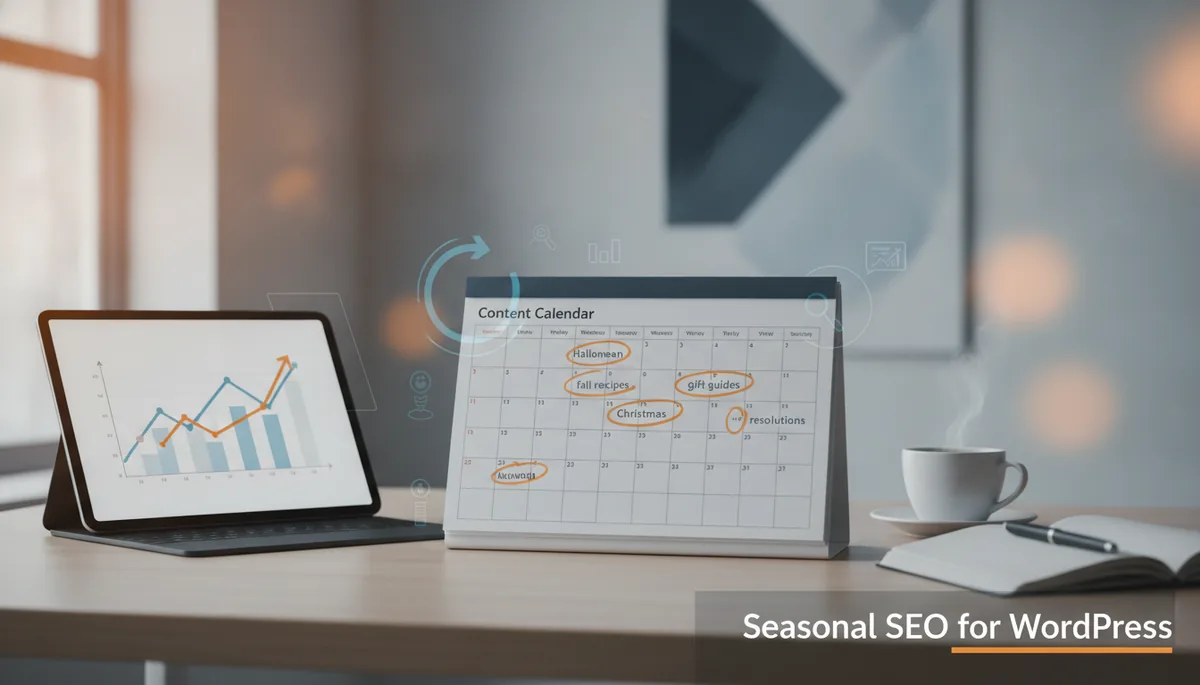
Convert seasonal insight into a tangible master calendar. Create a single spreadsheet or calendar view that links each holiday or shopping event to the product pages and blog categories that should carry the message. For Shopify, assign product or collection pages to events; for WordPress, assign blog categories or series. Example: Valentine’s Day maps to “Gift Guides,” “Date-Night Essentials” product collections, and a “How to Choose the Perfect Gift” blog series published two to three weeks before the spending spike.
Build topic clusters: pick a pillar seasonal theme (e.g., “holiday gift guides”) and 4–6 supporting posts that answer shopping intent—buyer guides, comparisons, best-of lists, and unboxing videos. Tag content consistently with event and season tags (season:winter, event:BlackFriday, campaign:Countdown). Those tags feed Trafficontent workflows to surface the right drafts and trigger automations at the right time. Prioritize high-traffic product pages for extra support: add internal links from seasonal blog posts to those product pages, and consider temporary promo badges or banner placements in Shopify to increase conversion during the peak window.
Build a step-by-step seasonal content calendar (practical workflow)
Turn planning into a sequence you can repeat. Use this four-step framework to keep the team focused and on deadline:
- Define seasons, events, and measurable goals. Map holidays and regional cycles relevant to your audience. Set targets (organic traffic %, conversion lift, email list growth).
- Assign owners and publish windows. For each piece, assign an owner, set draft/review/QA deadlines, and schedule publication 2–4 weeks before peak shopping days. Trafficontent’s workflow templates and Smart Scheduler make this timing visible and repeatable.
- Create topic briefs and asset lists. Standardize briefs: audience angle, primary keyword, word count, headers, CTA, and required assets (hero image, product shots, thumbnails). That reduces review cycles and speeds production.
- Schedule reviews and approvals. Build milestones—draft due, review complete, QA pass, final sign-off—with automated reminders. In Trafficontent, map each role to the editorial calendar so approvals don’t become bottlenecks.
With this process, you avoid last-minute scrambles and gain the ability to reuse templates and tags year after year. The cadence also makes it easy to reassign or scale efforts if a trend accelerates unexpectedly.
Automate publishing with Trafficontent: cross-platform workflows
Automation is where seasonal planning scales. Connect Shopify and WordPress to Trafficontent and design cross-platform workflows that publish, tag, and promote content without repeated manual steps. A simple setup sequence looks like this:
- Authenticate your Shopify store and WordPress site in Trafficontent.
- Create a campaign or event tag (e.g., event:BlackFriday) and define content types (product page updates, blog posts, social posts, emails).
- Set auto-publish rules: drafts with tag event:BlackFriday and status:approved → publish on WordPress and push a linked collection update to Shopify on the chosen publish date.
- Use the Smart Scheduler to pick optimal publish times based on historical traffic windows for your site and audience.
Trafficontent’s Blog Automation can ensure posts are formatted with your SEO defaults and metadata, while Social Media Automation and Newsletter Automation queue cross-channel variants automatically. For example, a product-focused blog post published on WordPress can trigger a Shopify collection banner, an Instagram carousel, and an email teaser—each with tailored copy and UTM parameters—coordinated by one event tag. These cross-platform workflows free your team to focus on strategy and creative, not copy-paste publishing tasks.
AI-assisted keyword research for seasonal ecommerce content
Seasonal SEO is about timing and specificity. Use AI to surface long-tail, intent-rich queries that spike around holidays—a more efficient approach than targeting broad, highly competitive terms. Start by feeding your event, product categories, and a seed keyword into Trafficontent’s SEO Workflow Automation or your favorite keyword tool to generate holiday-specific variants: “best eco-friendly Christmas stocking stuffers,” “back-to-school laptop deals for college students,” or “Black Friday blender bundle deals.”
Evaluate each idea against three criteria: search intent (informational vs transactional), ranking difficulty, and potential ROI. During busy seasons, prioritize lower-difficulty long-tail keywords with clear transactional intent that can be supported by product pages or bundles. Create brief keyword maps that pair a primary commercial keyword to a product or collection page and supporting informational keywords to blog posts. For example, map “cordless drill deals” to a product collection and “how to choose a cordless drill for home projects” to an evergreen blog guide that links to the collection.
Remember to account for seasonal shifts in intent—users who search earlier in the cycle may be researching, while late-cycle searchers are ready to buy. Use staged content: early informational guides that answer questions, followed by price-focused posts and urgent CTAs as the event approaches.
Optimized blog post templates and SEO for ecommerce on WordPress
A repeatable post template speeds production and improves performance. For seasonal ecommerce posts on WordPress, use the following template elements and SEO best practices:
- Title: Include the seasonal hook and primary keyword (e.g., “Top 12 Mother’s Day Gifts for New Moms — 2026 Guide”).
- Meta description: Concise benefit + CTA and keyword; keep under ~155 characters.
- Headers: H1 for title, H2s for section breaks (why it’s a good gift, how to choose, top picks), H3s for item details. Use keywords naturally in at least one H2.
- Internal linking: Link to 2–4 high-priority product or collection pages early and throughout the post to pass SEO equity and improve user flow.
- Image SEO: Use product shots and lifestyle images, compress for speed, add descriptive alt text with keywords, and include an image caption that links to a product when useful.
- Product schema: Where applicable, add schema markup for product, price, availability, and reviews to help rich results. WordPress plugins or Trafficontent’s templates can pre-fill schema fields from Shopify data.
- CTA: Add a clear CTA near the top and at the end—e.g., “Shop the Mother’s Day Collection” with a UTM-tagged link to the collection.
Standardize these elements in a WordPress post template within Trafficontent so writers start with SEO-ready fields and images. That consistency reduces QA time and improves on-page performance across seasonal posts.
Multichannel content planning: social posts and product promotions
Seasonal traffic is rarely driven by a single channel. Coordinate blog posts, social, and email so each touch nudges a shopper closer to purchase. Use Trafficontent to create one campaign that publishes a primary blog post and then generates channel-specific assets automatically. Key tactics:
- Stagger content: publish the long-form guide first, then promote snippets on social, followed by a reminder email; finally, post last-minute urgency content 48–72 hours before the event.
- Adapt messaging per channel: short, visual carousels for Instagram; value-driven subject lines for email; keyword-rich captions and link previews for Facebook and Twitter.
- Add UTM tracking to every link so you can attribute traffic and conversions back to channel and piece of content.
- Use promo bundles and time-bound codes highlighted across channels; set up dedicated landing pages so performance is easy to track.
Trafficontent’s Social Media Automation allows you to schedule a sequence of posts that reference the same blog or collection, each with unique copy and scheduling cadence. This avoids repetitive posts and keeps messaging fresh. For example, a gift guide could spawn: a teaser post, a carousel highlighting top picks, a behind-the-scenes video, and a last-call promotional post—with all links tracked and attributed to a single campaign.
Measure impact and refine cadence post-season
After the season, move quickly from celebration to analysis. Pull core KPIs—organic traffic, page views, time on page, conversion rates for product pages, email CTR, and revenue attributed to seasonal content. Use Trafficontent dashboards connected to Shopify and WordPress to get a unified view and compare year-over-year trends. Look for patterns: which blog posts drove product page visits? Which social posts had the best CTR? Which segments (new vs returning customers, geography) reacted strongest?
Segment the analysis by audience, channel, and product category so you can replicate what worked and drop what didn’t. For example, an analysis might show blog sessions rose 28% during the season and average time on page increased 14%, but gift-guide conversions only improved modestly. That tells you content succeeded at discovery but that product pages or checkout flows need conversion attention next season.
Create a short post-mortem that captures top wins, measurable gaps, and at least three tactical changes for the next season—timing shifts, new keyword targets, or revised email cadences. Feed those changes into the next master calendar and use Trafficontent’s workflow templates to lock in improvements.
Collaboration, governance, and continuous improvement
Seasonal content is a team sport. Set governance rules so quality and brand voice remain consistent while production scales. Define who approves content, what SEO and imagery standards must be met, and the sign-off path from draft to publish. Map these roles in Trafficontent’s editorial calendar to prevent bottlenecks and set automated reminders for reviewers.
Schedule recurring content audits—quarterly or post-season—to refresh evergreen guides, prune outdated holiday references, and repurpose well-performing posts into new formats (video, carousels, or product bundles). Use a simple rubric for decisions: update, retire, or repurpose. Capture lessons learned in a short playbook so next year’s team doesn’t reinvent the wheel.
Real-world example: a mid-sized Shopify store used Trafficontent to run a holiday campaign combining 12 blog posts, videos, and 6 email sends. SEO automation kept keyword focus, Smart Scheduler timed posts for peak windows, and newsletter automation coordinated promotions. Results: blog sessions rose 28%, average time on page grew 14%, email CTR increased from 1.9% to 2.8%, and gift-guide page conversions improved from 2.4% to 3.5%, driving an overall ~12% holiday revenue lift. Those measurable outcomes were only possible because the project had clear ownership, consistent tags, and cross-channel automation.
After each season, document the top three repeatable plays—content types, timing, and channels—that produced the best ROI and bake them into your next calendar so wins compound year over year.
Next step: open your Trafficontent calendar, tag three upcoming seasonal events, and schedule a 30-minute sprint to map each to one product page, one blog post, and one social sequence—then let the Smart Scheduler do the heavy lifting.