If holiday content feels like throwing glitter at a wall and hoping some of it sticks, you’re not alone. I’ve run WordPress sites that went from tumbleweeds in November to standing-room-only in December — and I’ve learned the repeatable stuff that actually works. This guide walks you through building a WordPress-first seasonal content system: define goals, plan a calendar, use proven content templates, optimize for search, harden your site for traffic surges, automate the boring parts, and measure what matters so next year you don’t reinvent the sleigh. ⏱️ 10-min read
Seasonal goals and audience intent for holiday content
Before you light the holiday lights, decide what you want to measure. Are you after raw traffic (the kind that makes your analytics graph spike like it had too much eggnog), email signups, actual revenue, or social engagement? I always start with one clear KPI and a secondary KPI. For example: primary goal — 20% lift in holiday revenue; secondary goal — 1,000 new email subscribers. Without that north star, your content calendar becomes a festive scavenger hunt where no one wins the prize.
Next, match holiday intent to topic. Audiences search differently during the holidays: “gift ideas for her under $50” and “best slow cooker turkey recipes” are transactional or purchase-intent queries, while “how to wrap a cookbook like a pro” is informational. Create an intent map: list holidays that matter to your niche (Black Friday, Cyber Monday, Halloween, local festivals, niche observances like National Pet Day) and annotate each with likely search intent and conversion opportunity. If you sell artisanal candles, Thanksgiving and Christmas might be your best bets; Arbor Day, not so much — unless you’re making tree-hugging candle holders, in which case, power to you.
Finally, align the content with product and audience segments. Break your audience into logical groups (new visitors, past buyers, email subscribers) and design content that nudges each group toward the goal. New visitor content should be discovery-focused (roundups, listicles). Repeat buyers get loyalty offers and early access buys. Email subscribers get gated guides or exclusive bundles. I once doubled conversions by creating two parallel holiday funnels — one for first-timers and another for returning customers — which meant the right headline and CTA landed in front of the right eyeballs. It’s like making sure the eggnog is spiked for adults and the sparkling cider is labeled clearly for the in-laws.
WordPress seasonal content calendar framework
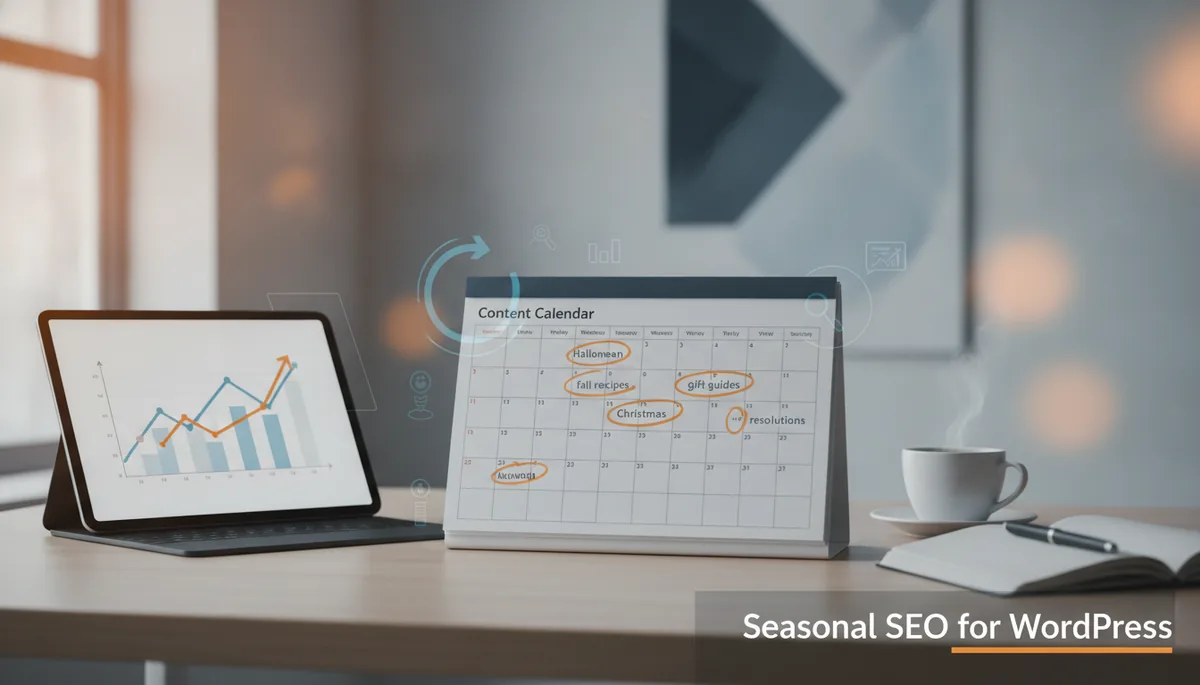
A calendar is the blueprint that stops holiday marketing from descending into chaos at 11:59 p.m. on December 23rd. I use a single master calendar (Notion for planning, Google Calendar for deadlines, and Editorial Calendar plugin for in-dashboard scheduling). Centralize everything: topic, target keyword, publish date, promotion window, assigned author, visuals, and CTA. Put promotion windows on the calendar just as prominently as publish dates — your post is only useful if people see it.
Make the calendar reusable. Create a template with slots for evergreen holiday content (gift guides, last-minute ideas), timely pieces (Black Friday deals), and localized items (local events, store hours). Each slot should have fields for internal links and pillar pages. A “holiday gift guide” slot, for instance, should link back to a product category page with tracked UTM parameters so you can attribute conversions later. Treat internal linking like a funnel: many seasonal posts should feed into a handful of conversion-oriented pillar pages, then to checkout.
Plan the promotion cadence. For each post, schedule a pre-publish teaser, a publish-day push, and several follow-ups across platforms. Use recurring templates: week -2 teaser, week -1 preview, day 0 publish, day +3 reminder, day +7 evergreen push. Assign ownership clearly so no one assumes the intern scheduled it — because they probably didn’t, and the intern is now became the leading suspect in a mystery thriller called “Where Are The Promo Assets?” Use a plugin like CoSchedule or an Editorial Calendar plugin to sync the editorial plan inside WordPress, which saves you hopping between tools when you need to update a publish date at midnight.
Holiday content formats and template ideas
Some content formats are holiday gold because they match short attention spans with direct intent. I prioritize listicles (gift guides), roundups (best tools for holiday baking), how-tos (how to host a stress-free virtual family dinner), and product reviews. These formats are scannable, shareable, and convertable — exactly what harried holiday shoppers and procrastinators need. Think of them as the fast food of useful content: quick, satisfying, and sometimes life-saving at 11 p.m. on December 23rd.
Build a bank of reusable templates so you can crank out posts in a day, not a week. Example templates:
- Gift Guide Template: intro with audience hook, top picks with thumbnail, price, buy link, quick pros/cons, and a “shop the collection” CTA.
- Roundup Template: category intro, curated list sorted by theme (budget, splurge, eco-friendly), and an email capture popup with a printable checklist.
- How-To Template: estimated time, tools/materials list, step-by-step numbered instructions, and an embedded checklist for download.
- Product Review Template: unboxing, test criteria, pros/cons, verdict, and affiliate link disclosure.
For speed, create content snippets: pre-written review blurbs, standard ALT text, stock intro/opening lines, and standardized image overlays (product title + price). I use these snippets like culinary mise en place — everything prepped so the actual cooking (writing) takes minutes. Also, have a fallback image set and OG (Open Graph) templates for social sharing. If your design skills are limited, use free themes that look professional or a page-builder pattern that becomes your holiday layout. The goal isn’t to win a design award; it’s to look trustworthy enough that people hand over their credit card details without blinking suspiciously.
SEO and keyword strategy for holiday posts
Holiday SEO is a sprint with marathon implications. Start with holiday-specific keyword research. Use Google Keyword Planner, Ahrefs, Ubersuggest, or seasonal prompts from your content tool to surface the exact phrases shoppers use: “best stocking stuffers for teens,” “Black Friday deals TVs,” “last-minute Christmas gifts.” Focus on long-tail terms with clear buying intent — they’re lower competition and more likely to convert for small sites.
Group keywords by intent and calendar date. Make a simple spreadsheet with columns for keyword, search volume, competition, page owner, target publish date, and schema type. Target high-intent transactional keywords 3–6 weeks before the event for buying windows; informational or “how-to” pieces can go up earlier to build authority. Optimize titles by putting the keyword toward the front, but keep it natural. Meta descriptions should be concise, value-driven, and include a CTA — think “Shop now,” “Find deals,” or “Download checklist.” Use WordPress SEO plugins like Yoast or Rank Math to preview snippets and guide on-page optimization. For schema, add Product, FAQ, and Recipe markup where relevant so search engines can show rich results — Google’s Structured Data documentation is a decent place to start: https://developers.google.com/search/docs/appearance/structured-data
Don’t forget Open Graph and Twitter Card metadata — that snippet controls how your content appears across social platforms. A great-looking OG image can materially increase click-through rates when pins or tweets appear in feeds, so keep a consistent visual template and test variations. Finally, monitor rankings and CTRs for your holiday pages and iterate: tweak titles and metadata for poor-performing snippets, and use A/B testing on headlines in email campaigns to see which phrasing draws the most clicks. SEO isn’t magic; it’s observation and adaptation. Treat your holiday posts like living things that need small, timely edits to thrive.
WordPress setup for holiday traffic spikes
Imagine a sky-high holiday sale and your site responds like a sleepy sloth. Not great. Preparation beats panic. Start with a fast theme — prioritize speed and clarity over bells and whistles. Lightweight free themes like Twenty Twenty-Three or Astra (free version) look clean and perform well. Use page templates for holiday landing pages so you’re not rebuilding from scratch. Test mobile layouts aggressively; a surprising number of holiday shoppers browse and buy on phones while pretending they’re multitasking.
Caching and CDNs are non-negotiable. Install a caching plugin like WP Rocket (paid, but worth it for many sites) or LiteSpeed Cache if your host supports it. Enable full-page caching, minify CSS/JS, and use lazy loading so the critical above-the-fold content appears quickly. A CDN like Cloudflare reduces latency and distributes assets globally — particularly helpful if you have visitors across time zones. Learn more about CDNs here: https://www.cloudflare.com/learning/cdn/what-is-a-cdn/
Check your hosting plan and enable auto-scaling if you expect traffic surges. If you’re on shared hosting and expecting a big holiday, consider moving to managed WordPress hosting or a cloud provider that can scale. Always test backups and have a rollback plan. Run a staging environment to test promotions, new plugins, and checkout flows before they go live. Load test checkout pages and simulate peak traffic to ensure your payment processor and inventory systems hold up. Security matters too: enforce strong passwords, limit login attempts, and enable a WAF (Web Application Firewall). Nothing kills holiday joy like a hacked landing page and a frantic midnight patch party — unless you enjoy that sort of adrenaline rush, in which case, you’re a glutton for punishment.
Automation and content creation workflow
Automation is the espresso shot of holiday content operations: it keeps things moving without jittery mistakes. Build an efficient workflow that starts with content briefs and ends with scheduled social posts and tracked UTMs. I use a hybrid of human judgment and AI-assisted drafting — AI to generate outlines, metadata suggestions, and image prompts, while humans edit for tone, accuracy, and brand fit. Tools like Trafficontent can jump-start drafts, create images, and help schedule across channels, but don’t hand the whole holiday show to a bot unless you enjoy generic copy that smells faintly of algorithmic nostalgia.
Create standardized briefs: target keyword, headline options, audience segment, promotion schedule, internal linking targets, and image specs. Keep these briefs in your editorial calendar so contributors don’t have to hunt for context. Use templates for social posts and email subject lines to speed approvals. Batch produce assets: spend one day shooting product photos or creating OG images for multiple posts so assets are ready when the copy goes live.
Schedule everything in advance. Queue posts with scheduling tools or WordPress’s native scheduler, and pre-schedule social pushes using a tool that supports the networks you care about (Trafficontent, Buffer, Hootsuite). Use consistent UTM parameters for holiday campaigns so revenue and conversions are traceable back to the specific post or promotion. Automate reporting dashboards to surface KPIs in real time — weekly email recaps during the holiday window help the team react quickly. Remember: automation should reduce friction, not remove humans from decisions that matter. Let the tools handle repetitive tasks; retain people for strategic moves, customer responses, and that last-minute creative pivot that often wins the season.
Distribution and cross-promotion plan
Publishing a great post and crossing your fingers is like launching fireworks in fog — pretty, but not always visible. Coordinate distribution across platforms with a platform-specific mindset. Pinterest is often the holiday traffic MVP for gift guides and recipes; treat Pins like mini-landing pages with clean images and keyworded descriptions. X (Twitter) is great for flash deals and one-liners, LinkedIn works for B2B holiday thought leadership, and email still converts best for people who already know you. Don’t be scared to repurpose one piece into many formats — a single gift guide can become pins, a carousel, an email series, and a 60-second video.
Repurpose with purpose. Turn list items into carousel slides for LinkedIn and Instagram, chop a how-to into short Clips or Reels, and export quotes for story posts. Create a distribution checklist per post: publish, pin (3 sizes), tweet variations (short + long), LinkedIn post, 2-3 email blasts, and paid boosts for top-performing pieces. Reserve 10–20% of your promo budget for paid boosts on high-value pieces — a little promotion can turn a decent post into a traffic magnet.
Coordinate with partners and influencers. Send a small, clear asset pack — headline options, images in the right sizes, suggested captions, and U