If your WordPress site feels like it’s serving pages via carrier pigeon, this guide is for you. I’ve spent years nudging sites from sluggish to sprightly—boosting Core Web Vitals, calming layout shifts, and adding structured data so search engines actually understand the story your content tells. Think of this as a practical playbook: real steps, tool calls, and a few sarcastic analogies (because performance tuning without humor is just painful). ⏱️ 10-min read
By the end you’ll have a measurable baseline, a prioritized checklist for hosting, caching, and mobile-first fixes, and a straightforward plan to inject JSON-LD that helps Google present your posts as richer results. I’ll also point to the right tests and plugins so you don’t have to reinvent the wheel—just turn it faster.
Speed foundations: Core Web Vitals and benchmarks
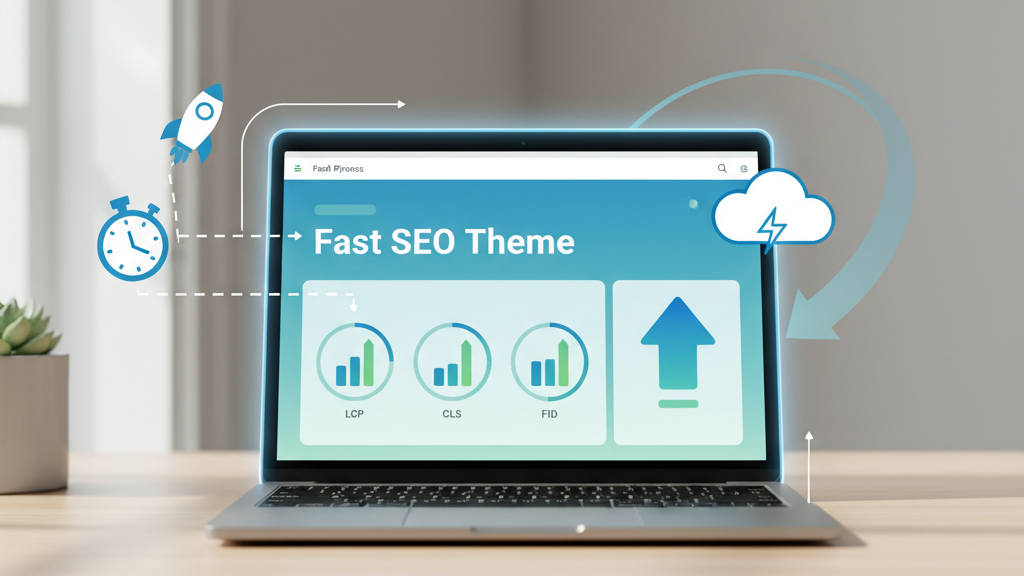
Core Web Vitals are Google’s way of asking, “Does this page feel fast and usable to a human?” They’re quick, objective checks that correlate with user satisfaction and, increasingly, rankings. The three you must know are:
- Largest Contentful Paint (LCP): when the main content appears. Target: ≤ 2.5 seconds for a good experience.
- First Input Delay (FID): how fast the page responds to the first user interaction. Target: < 100 ms (note: Google has introduced INP as an evolving interactivity metric—keep an eye on both).
- Cumulative Layout Shift (CLS): how stable the layout is during load. Target: < 0.1.
In plain terms: LCP is “did the hero content arrive quickly,” FID is “did my tap not feel ignored,” and CLS is “did something jump and make me curse under my breath.” WordPress sites often sit between 2.5 and 4.0s for LCP by default; that’s like showing up to a date five minutes late and blaming traffic. The good news is small wins compound: a lean theme, smart caching, and optimized images can push numbers into the green faster than you’d think.
Make an audit workflow with Lighthouse (local testing and CI-friendly), PageSpeed Insights (field + lab data), and Google Search Console’s Core Web Vitals report (real user metrics). Run tests on both mobile and desktop, record baseline scores, and pick no more than three high-impact goals for the next sprint. I always start with LCP on the homepage and a top-performing blog post—the rest follows.
Reference: Google’s Core Web Vitals overview is a great refresher: https://web.dev/vitals/
Funny aside: tuning metrics is like exercise—one heavy squat (image optimization) does more than ten sit-ups (changing a font setting) when done right.
Hosting, caching, and CDN for WordPress speed
Hosting sets the baseline—if your origin server is slow, everything else feels sluggish no matter how pretty your code is. For WordPress, favor hosts with Nginx, PHP 8+ (or 8.1+), NVMe storage, and HTTP/2 or HTTP/3 support. Managed WordPress plans (Kinsta, WP Engine, or similar) often beat bargain shared hosting because they combine tuned stacks, backups, and fewer surprises. Cheap shared hosting is fine for learning, but it’s not where you build a high-traffic site—unless you enjoy surprises and downtime like it’s a hobby.
Caching is the single most reliable speed lever:
- Page caching: serves pre-built HTML so PHP doesn’t run on every request. This is the big win.
- Object caching: use Redis or Memcached for repeated DB queries (especially for expensive plugins or high-traffic pages).
- Opcode caching: Opcache is a must—compiled PHP stays hot and avoids re-parsing on each request.
- CDN/edge caching: push static assets (and even cached HTML) to edge nodes using Cloudflare, KeyCDN, or StackPath to shorten round-trips for distant visitors.
Practical stack: pair a managed host or a VPS running PHP 8+, enable Opcache, install a caching plugin like WP Rocket (or host-native caching), and add Cloudflare for CDN + DNS + optional edge rules. Then minify and combine assets cautiously (Autoptimize is handy), enable lazy loading for offscreen images, and set long cache lifetimes for static files. Don’t forget to test after each change—minification can go from hero to villain if scripts break.
Reference: PageSpeed Insights and Lighthouse are your baseline tools for spotting server-response and render-blocking issues: https://developers.google.com/speed/pagespeed/insights/
Sarcastic line: think of a CDN like hiring a courier who actually knows your city—no more parcels lost in the server basement.
Mobile-first performance and UX
Most visitors are on phones. Build mobile-first: a responsive theme + fluid typography + touch-friendly controls. Use CSS grid or flexbox with relative units (rem, vw) and clamp() for headings so copy scales elegantly from a 360px handset to a 4K monitor. I once fixed font-overflow issues by switching a theme from px to rem—felt like giving the site reading glasses.
Key mobile wins:
- Inline critical CSS for above-the-fold elements and defer non-critical CSS to avoid render-blocking.
- Load hero images sized to the actual display size; move everything else to lazy loading (use loading="lazy").
- Optimize web fonts: preconnect to font origins, limit font variants, and use font-display: swap so text appears even while fonts load.
- Trim JS: defer or async nonessential scripts and split bundles. If the mobile page loads 1.5 MB of JS before interaction, that’s not a site—it’s a ship anchor.
Accessibility matters too: make tap targets at least 44x44px, keep body text at or above 16px on mobile, and ensure contrast ratios are comfortable. Avoid full-screen popups on mobile—they punch users in the face and kill engagement. Test on a real phone rather than relying on simulation: simulators don’t always reproduce the lag from CPU throttling or mobile networks.
Practical tip: use lazy-loading for all secondary images, but explicitly exclude above-the-fold images from lazy behavior. I’ve had pages where the hero image was lazy-loaded—yes, the LCP culprit was politely sleeping on the job.
Funny comparison: delivering the full desktop JS bundle to mobile is like giving a toddler a toolbox—pointless and likely to break something.
Structured data that Google loves: JSON-LD for posts, FAQs, and breadcrumbs
Structured data (JSON-LD) is the polite way of telling Google exactly what your content is, without stuffing meta tags or creating awkward HTML. For WordPress publishers, focus on Article/BlogPosting, BreadcrumbList, and FAQPage where applicable—these help with eligibility for rich results and clearer search snippets.
What to include for BlogPosting:
- headline, datePublished, dateModified, author, mainEntityOfPage (URL), image, and publisher (with logo).
- Use BreadcrumbList with itemListElement to map position, name, and item (URL).
- Implement FAQPage with mainEntity arrays containing Question and acceptedAnswer—only for content that truly answers user questions.
Implementation paths:
- Use an SEO plugin that supports JSON-LD (Rank Math or Yoast) to auto-generate Article schema for posts.
- For FAQs or custom needs, create a small JSON-LD block inserted in the head via theme hooks or a custom block. Keep it tidy and update dynamically.
- Always validate with Google’s Rich Results Test and the Schema.org docs—broken schema can be worse than none at all.
Small JSON-LD example for a BlogPosting (trimmed):
{
  "@context":"https://schema.org",
  "@type":"BlogPosting",
  "headline":"How to Speed a WordPress Site",
  "author":{"@type":"Person","name":"Jane Doe"},
  "datePublished":"2025-01-10",
  "image":"https://example.com/hero.jpg",
  "mainEntityOfPage":"https://example.com/speed-guide"
}
Wire this into WordPress through a plugin or a custom block. I prefer using WordPress hooks when you want precise control; plugins are great for speed if they’re kept lean. After implementing, always run the Rich Results Test: https://search.google.com/test/rich-results
Sarcastic aside: adding FAQ schema for the sake of “rich results” without the actual answers is like putting a neon sign on a store with nothing inside—awkward and disappointing.
Content architecture and internal linking for SEO and crawl efficiency
Content architecture is the map you give search engines (and readers). I use a pillar-cluster model: a comprehensive pillar page covers the topic broadly and links to tightly related cluster posts that dig into specifics. This structure passes topical signals and directs crawl budget to the pages that matter—so Google spends time on your good stuff instead of index junk.
How I lay it out:
- Create pillar pages for broad topics (e.g., “WordPress Site Speed”) and supporting posts for subtopics (caching, image formats, CDNs).
- Link supporting posts back to the pillar and vice versa. Use descriptive anchor text—helpful for users and meaningful for crawlers.
- Keep URL structure shallow and readable: /wordpress-site-speed/caching rather than /category/2025/05/post-id.
Maintain an up-to-date sitemap and submit it to Search Console. Monitor crawl stats and index coverage to spot ignored or orphaned content. If a page never receives internal links, treat it as a lost sock: either rehome it under a relevant pillar or retire it.
Practical bonus: create a content inventory (spreadsheet or CMS export) and tag pages by intent and priority. That makes internal linking deliberate rather than accidental. I once reduced crawl waste by 40% on a site by pruning thin, duplicate posts and reassigning the best ones into clusters—traffic went up because Google stopped chasing squirrels.
Funny line: deep-nested URLs are the SEO equivalent of a hedgehog in a labyrinth—cute, but nobody wants to find it.
Plugins and themes that support speed and SEO: practical picks
Your theme and plugins are like a car’s chassis and engine: pick bad ones and you’ll always be fixing leaks. Choose lightweight themes and purpose-built plugins. I recommend testing with your real content before committing—a demo site with stock images rarely shows true layout or performance behavior.
Themes I trust:
- GeneratePress: lean, predictable, and great default performance.
- Astra: flexible with fast templates when you need quick builds.
- Lightweight block themes: great if you’re fully invested in the block editor and want minimal CSS/JS overhead.
Performance plugins to consider:
- WP Rocket: an excellent all-in-one for caching, minification, and lazy loading (premium).
- Autoptimize: great for aggregating/minifying CSS/JS and easy to test.
- PerfMatters: script manager to disable unused assets per page (massive win for plugin bloat).
- Image tools: ShortPixel, Smush, or EWWW for compression and WebP conversion.
- SEO: Rank Math (richer schema defaults) or Yoast (robust, widely used). Pick one and configure it—don’t run both.
Important caution: plugins can conflict—minification + CDN + host caching sometimes trip over each other. That’s why I test changes in staging and enable one optimization at a time. Also, avoid the temptation to install plugin fireworks—if it doesn’t directly improve load times, UX, or indexing, ask whether it’s worth the cost.
Sarcastic nugget: installing ten “speed” plugins is like hiring ten baristas to make one espresso—chaotic and highly caffeinated for no reason.
Ongoing optimization: audits, monitoring, and maintenance
Speed and SEO are not one-off projects. I run monthly performance audits and quarterly architecture reviews so improvements stick. Your monitoring toolbox should include Google Search Console, PageSpeed Insights, Lighthouse, and an uptime monitor like UptimeRobot. Export data weekly and look for trends—don’t chase daily noise.
Monthly checklist (practical):
- Check Core Web Vitals in Search Console for any pages trending down.
- Run Lighthouse or PageSpeed Insights on key pages (homepage, top 5 posts) and compare to your baseline.
- Scan for broken links and 404s; fix redirects and update internal links.
- Confirm backups, plugin/theme updates, and test in staging before pushing to production.
Quarterly tasks:
- Architecture review: retire or consolidate thin content, expand pillar pages, and rework internal linking.
- Schema audit: ensure JSON-LD still matches content and validate with the Rich Results Test.
- Cost-benefit review: is a premium service (CDN tier, image CDN) delivering measurable uplift? If not, iterate.
When something breaks, record it in a runbook: what changed, rollback steps, and the fix. I’ve learned the hard way that a rollback plan is less glamorous than a new plugin but infinitely more valuable.
Funny sign-off for this section: treat your site like a pet—not a Tamagotchi. Feed it updates, don’t ignore the warning lights, and for heaven’s sake don’t throw it off a cliff because a plugin asked for admin access.
Next step:
Run a Lighthouse audit for your homepage and one top-performing post today. Make a three-item action list: server response time, hero image size, and one structured data enhancement—then tackle them in that order. Small wins compound, and I’ll bet coffee you’ll see measurable improvements in a matter of weeks.
References: Google Core Web Vitals (https://web.dev/vitals/), PageSpeed Insights (https://developers.google.com/speed/pagespeed/insights/), Google Rich Results Test (https://search.google.com/test/rich-results)