Starting a blog is like adopting a pet tiger: thrilling, a little bit dangerous, and likely to end badly if you don’t set rules. I’ve launched and maintained blogs long enough to know that momentum beats perfection—every time. This guide lays out a repeatable, WordPress-ready content-calendar system you can actually keep up with: realistic cadence, content pillars, a calendar template, production workflows, automation, tools, measurement, and a 12-week starter plan. ⏱️ 11-min read
Read this as a conversation over coffee (I’ll bring the sarcasm, you bring the ambition). By the end you’ll have a practical plan and a starter checklist that turns fuzzy intentions into publishable, SEO-friendly posts without turning your evenings into a caffeine marathon.
Start with clear goals and a sustainable cadence
Before you whirl into headlines and hero images, ask why you’re blogging. It sounds existential—because it is—but your real "why" makes the difference between a blog that fizzles and one that becomes a steady corner of the internet. Is your aim to teach a hobby, build a community, document experiments, or support a side business? Pin this down. I once blogged for two months without a clear goal and wrote the internet equivalent of polite small talk; valuable, but forgettable.
Pick a cadence that fits your life, not your bravest Monday morning mood. For most new bloggers, one thoughtful post per week or one every two weeks wins. It’s enough to build momentum and keep search engines noticing without inviting burnout. Think of it like setting a gym schedule you’ll actually keep: aim for consistency, not heroics. I recommend a weekly rhythm with theme days—e.g., "Tutorial Tuesday" or "Story Sunday"—and one buffer post in reserve. Having a buffer is like keeping chocolate in the drawer for emergencies; it saves relationships and reputations.
Make publishing windows predictable. I block a 90-minute slot on a weekday morning for final edits and scheduling so posts go live at the same time each week. Your audience will appreciate the pattern and your future self will thank you when the calendar doesn’t feel like a surprise pop quiz. Finally, set small measurable goals: number of posts, email signups, and one traffic metric to track. These are your compass when vanity metrics try to seduce you into chaos.
Define content pillars and a robust topic ideation system
Content pillars are the spine of any sustainable blog. Pick 3–5 broad buckets that map to reader needs and your interests—these are the categories you’ll live in, not decorative labels. For example, my hobby blog leaned on How-To’s, Gear Reviews, Personal Stories, and Troubleshooting. Those categories made it easy to say "no" to shiny topic ideas that didn’t fit, which saved a lot of existential energy. Think of pillars like elevator music for your brand: familiar enough to be comforting, not so repetitive your readers run for the door.
Build an idea bank and keep it alive. Use a simple spreadsheet or Trello board with columns for Pillar, Idea, Status, and Notes. I keep 40+ raw topics in a "Someday Soon" tab and add seasonal and evergreen angles so nothing disappears into the void of forgotten inspiration. Capture ideas from reader questions, comments, search queries, and your own foibles—real pain points make the best posts because they solve something actual humans care about. Turning a reader question into a post is the greatest energy ROI on the internet—bigger than coffee, almost as addictive.
When ideating, think variety: how-to guides, short opinion pieces, checklists, and case studies. Assign intent to each idea (informational, transactional, navigational) so you balance traffic-building posts with conversion-friendly ones. Also schedule a regular "idea triage" session—30 minutes every two weeks to prune, promote, or kill ideas. Not every seed grows into a tree; sometimes it’s a shrub that’s fine but not worth the water.
Design a WordPress-ready content calendar template
Your calendar needs to be visible, simple, and useful—or it becomes an expensive paperweight. Choose a tool you actually use: Google Sheets if you like minimalism, Notion for a richer workspace, or Trello if kanban makes your brain happy. I started with Google Sheets and moved to Notion once I wanted templates and linked resources. Pick what you’ll open first thing; that’s the real test.
Essential fields to include: Date, Publish Date, Content Pillar, Topic, Keyword, Status, Author, SEO Title, Meta Description, Internal Links, Visuals, and Notes. Use Date to schedule writing sessions, Due Date for drafts, and Publish Date for the live moment. Add short reminders for SEO elements—keeping them in the calendar makes optimization part of planning, not a frantic afterthought. If that sounds like too much, strip it back to Date, Topic, Pillar, Status, and Keyword—then expand as you grow.
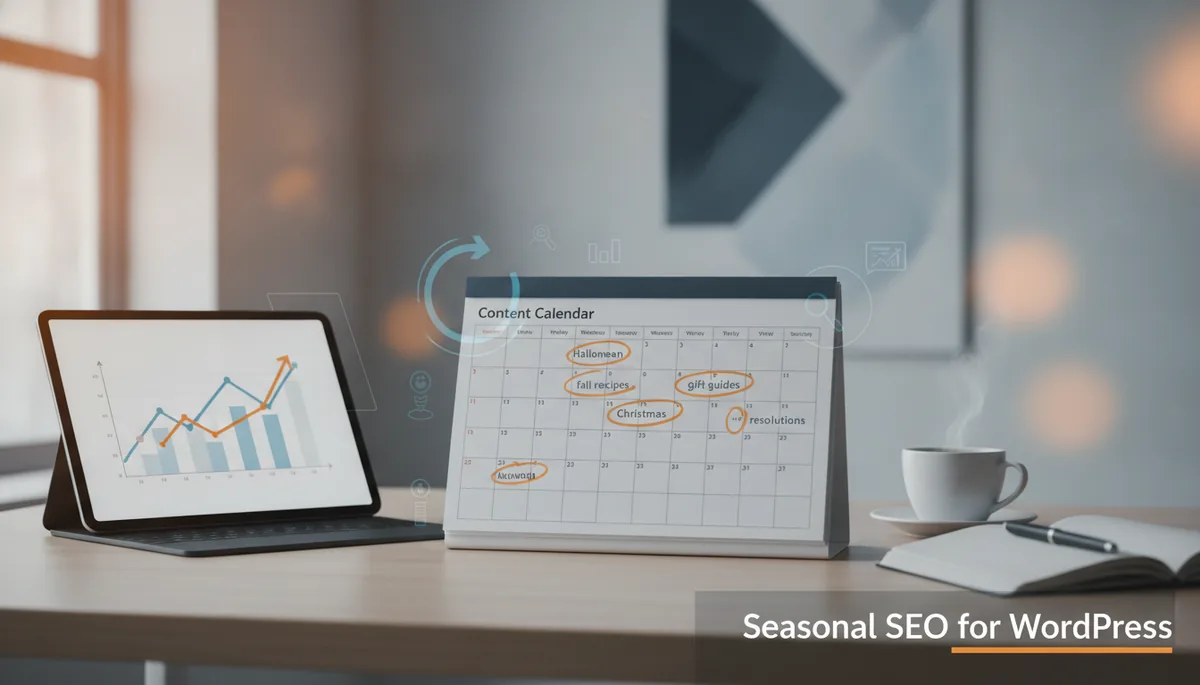
Schedule quarterly clusters: group 3–6 posts around a theme or long-term keyword to build internal linking and topical authority. Reserve space for evergreen updates—slots every 3–6 months to refresh top posts. For automation, tools like Trafficontent can populate SEO fields and even handle scheduling if you prefer less manual grunt work. Finally, color-code statuses—Draft, In Review, Scheduled, and Published—so your calendar looks like a functioning interface, not a Jackson Pollock painting.
Create templates for fast, SEO-friendly posts
Templates speed you up and reduce decision fatigue. I use a short, repeatable post template for every article: Hook, What this post solves, Step-by-step subheads, Practical examples, Quick checklist, and Final takeaway. This structure keeps readers engaged and gives search engines predictable signals. Think of it as a reliable sandwich recipe—same base, tasty variations.
Here’s a simple post template you can copy immediately:
- Title (SEO-friendly, under 60 characters)
- Hook (1–2 sentences that promise value)
- What you’ll learn (bullet list)
- Sectioned body with H2/H3 subheads
- Short practical examples or screenshots
- Actionable checklist or CTA
- Meta description (under 155 characters)
Inside WordPress, create reusable blocks for common elements: intro boilerplate, callout boxes, and a closing checklist. Save them in the Block Library so writing is less like sculpting marble and more like assembling LEGO. Keep a one-click SEO checklist (target keyword, title tag, meta, alt text, internal links) and run it before you publish. Templates aren’t creative handcuffs—they’re speed gear. Use them and you’ll publish more with less existential dread. Also, if you ignore this step you’ll spend three hours formatting a post and call it "research."
Build production workflows and checklists
A workflow is a promise to your future self that you won’t fall apart when deadlines arrive. I use a five-phase loop: Ideation, Outline, Draft, Edit, Optimize. Time-box each phase—15–30 minutes for ideation, 45–90 minutes for outlining, 60–120 minutes for a draft (depending on length), and a focused 30–45 minute edit. This keeps progress moving without letting perfectionism hijack every post. It’s like interval training for your brain—intense bursts with rest built in.
Pre-publication checklist (copy this and stop winging it):
- Confirm target keyword in title, URL, and first 100 words
- Meta description written and under 155 characters
- H1/H2 structure logical and scannable
- Images optimized (file size, alt text, licensing checked)
- Internal links to 2–3 relevant posts and an external reputable source
- Readability pass and spellcheck
- Publish schedule set and social share copy drafted
Batch similar tasks to reduce context switching. For instance, do all keyword research for the week in one session, then outline two posts back-to-back. When I batch images and formatting, I often finish the week’s content in half the time—and with fewer curse words. Tools like Trello, Notion, or Asana keep tasks visible; cards and checklists prevent things from vanishing into single-sentence to-do lists. If you're working with others, set clear owners and a review cadence—nothing kills momentum like waiting for feedback without a deadline.
Publish and distribute with automation
Publishing is the ceremony; distribution is the megaphone. Schedule posts in WordPress so you never miss your ideal publish window. Then automate distribution to social platforms where your audience lives—start small with two channels you can maintain. For many bloggers, Pinterest (for discovery), X (short updates), and LinkedIn (professional content) are useful. Tools like Trafficontent can automate cross-posting, queueing content across Pinterest, X, and LinkedIn so your blog works while you sleep or actually live life.
Repurpose ruthlessly: one long how-to can become a newsletter summary, three social posts, and a Pinterest pin. I turn every post into a short email with a single CTA and a 3–5 tweet thread or LinkedIn post that teases the problem-solution dynamic. Schedule those repurposed assets for the week of publication and then again at 4 and 8 weeks. Automation keeps you present in feeds without turning your afternoons into a full-time PR job.
Remember the 80/20 rule: spend 80% of your distribution energy where your readers are, not where everyone else says you should be. Be helpful in communities before spamming links—answer a question or provide a snippet without pushing your URL, then drop the link where it's relevant. This approach gets better long-term results than scattershot self-promotion. Also, pro tip: write your social copy the same day you outline the post; the messaging is clearer when your head is already in the idea.
Tools, platforms, and starter setup
Choosing WordPress.com vs WordPress.org feels like choosing between a tidy rental and a fixer-upper with infinite potential. For absolute beginners who don’t want hosting headaches, WordPress.com can be fine. If you want full control, plugins, and SEO options, go self-hosted at WordPress.org. I recommend starting self-hosted once you’re committed to growth—it's not as scary as people make it and the flexibility pays off.
Essential starter plugins and tools:
- SEO: Yoast or Rank Math (choose one)
- Image optimization: Smush or ShortPixel
- Caching: WP Super Cache or W3 Total Cache
- Security: Wordfence or Sucuri basic options
- Analytics: Google Analytics GA4 (see below)
Pick a clean free theme that supports blocks and responsive design. Avoid heavy "multipurpose" themes that ship with everything and nothing. Keep your plugin list lean—each extra plugin is a potential update or conflict. If writing SEO-optimized content quickly is your priority, consider a service like Trafficontent to generate optimized drafts and automate publishing; it can be a force multiplier if you're short on time. Also, brief personal confession: I once spent three hours choosing fonts. Don’t be me. Choose a readable system font, get writing, and upgrade design later.
Measure performance and iterate with growth hacks
Measurement doesn’t need to be terrifying. Set up a GA4 property and confirm your site is tracking basic traffic: visits, traffic sources, top pages, and a couple of goals like email signups or time on page. You can learn a lot from a few numbers without becoming an analytics hermit. If you want to set up GA4, start at the Google Analytics site and follow their setup instructions—don’t let tag management intimidate you.
Track these metrics weekly and run a short two-week retrospective every month: pageviews, average time on page, bounce rate, top referral sources, and social engagement. Look for trends, not daily fireworks. If time on page is increasing and bounce rate is falling, your formatting and examples are working. If pageviews spike but time on page drops, the headline may be promising more than the content delivers—fix the hook.
Growth hacks that actually help:
- Refresh evergreen posts every 3–6 months (update stats, add internal links)
- Republish updated posts and notify subscribers—it signals freshness to search engines
- Test headline variants in social posts to learn what drives clicks
- Prune underperformers: if a post hasn’t gotten traction in 6–12 months, either improve it or remove it
Spotlight winners and create a mini playbook: replicate topics, formats, and internal linking patterns from posts that perform best. Data should guide creative choices, not strangle them. If analytics makes you feel like a lab rat in a spreadsheet maze, focus on three simple KPIs and iterate slowly—tiny improvements compound faster than dramatic overhauls.
12-week starter plan with an example calendar
If you want a literal road map, here’s a compact 12-week starter plan you can follow. It assumes one solid post per week, plus distribution and optimization tasks. I used this exact sequence to grow a hobby blog from tumbleweed traffic to steady reads in three months—no cloning required.
- Week 1 — Foundation: Choose your 3–5 content pillars. Set up WordPress (self-hosted recommended). Install essential plugins and GA4. Create your content calendar template. Write and schedule a "Welcome + Mission" post.
- Week 2 — Pillar Launch: Publish a pillar overview post (what readers can expect). Do keyword research for 12 initial topics (one per week). Batch social copy for the first four posts.
- Week 3 — First Core Post: Publish Post #1. Run the pre-publication checklist and schedule social distribution. Add internal link to the Welcome post.
- Week 4 — Process Repeat: Publish Post #2. Batch image creation for next four posts. Triage idea bank—add 10 new ideas to reach 40 total.
- Week 5 — Cluster Build: Publish Post #3. Start a 3-post cluster around a related keyword to build topical authority. Schedule repurposed email and social for the last three posts.
- Week 6 — Midpoint Review: Publish Post #4. Review GA4 data for early trends. Refresh metadata on posts #1–2 if needed. Create a lead magnet or simple email opt-in.
- Week 7 — Evergreen & Seasonal: Publish Post #5. Identify 2 evergreen posts to refresh and schedule updates for month 3. Plan a seasonal post for month 4 if relevant.
- Week 8 — Outreach & Links: Publish Post #6. Start a small outreach campaign to request links from 5 relevant sites or communities (be helpful, not spammy).
- Week 9 — SEO Deepen: Publish Post #7. Add internal linking between the week-3 cluster and newer posts. Optimize images for load speed. li