If you’re a WordPress blogger who’s sick of shouting into the void, this is the manual I wish someone slid across the café table to me when I first started. I’ll walk you through the exact on-page moves that actually move the needle — practical steps, plugin-friendly tips, and a few real-world examples so you can stop guessing and start ranking. ⏱️ 11-min read
Think of this as the espresso shot of SEO: short, sharp, and it gets you moving. I’ll share what to do, why it matters, and how to implement it today. No fluff, no weird tricks — just the on-page fundamentals that Google rewards when you do them well.
Keyword research and intent alignment
Keyword research isn’t about finding the fanciest, highest-volume phrase and praying for the best. It’s about pairing realistic search volume with clear user intent. I always start with a tool — Ahrefs, Semrush, or Google’s Keyword Planner — to spot phrases with reasonable traffic and manageable competition. Then I open a browser and actually read the SERP. If the top results are how-to guides and you’re planning a product page, you’ve got an intent mismatch and Google will politely ignore you like a bad date.
Map each post to one primary keyword and a handful of long-tail variants. For example, if your primary is “best budget coffee maker,” long-tails could be “best budget coffee maker for small kitchens” or “best $50 coffee maker review.” This mapping keeps your content focused and prevents multiple posts cannibalizing each other. When I audited my own blog, pairing intent to keywords helped a guide move from page two to the top five in about three months — not overnight magic, but steady, sensible work.
Quick checks to do now:
- Use a keyword tool to evaluate search volume and difficulty.
- Scan the SERP: are results informational, commercial, or transactional?
- Pick a primary keyword and 3–5 supporting long-tails that match the same intent.
Do this, and you’ll stop chasing vanity keywords and start earning visits that actually convert — like choosing the right key for a lock instead of shaking every keychain in the drawer. For a deeper primer, see Google’s Search Central guide on how Google crawls and understands intent: Google Search Central.
On-page elements: titles, headings, and meta descriptions
Your title tag and meta description are your digital handshake in the SERP — make them firm and memorable, not limp and forgettable. Put the primary keyword near the front of the title, keep it under ~60 characters so search results don’t chop it, and make sure your H1 mirrors that promise. If your title is a clickbait-y carnival barker, readers will bounce faster than a rubber ball.
Headings are your content’s roadmap. Use H2s and H3s to break the post into scannable chunks and sprinkle secondary keywords where they fit naturally. In WordPress, plugins like Yoast SEO or Rank Math make it easy to preview and edit these elements without guessing how they’ll look in search results. I use these tools like a sous-chef uses a sharp knife: they speed things up and make the final dish look professional.
Meta descriptions should summarize the value and include a small call to action — but not like a used-car salesman. Think: “Save 30 minutes with this step-by-step guide.” Keep it conversational and useful; don’t cram keywords in like raisins in a fruitcake.
- Title: keyword near front, clear promise, ~50–60 characters.
- H1: match title intent and be human-readable.
- Meta description: describe value + CTA, 120–155 characters.
- Use H2/H3 for scannability and drop secondary keywords naturally.
Done well, these elements improve both rankings and click-through rate. For a technical deep dive on title best practices, Moz’s title tag guide is a great resource: Moz: Title Tag.
Content quality, structure, and readability
Google rewards answers — not essays that read like a tortured legal document. Your job is to answer the user’s question quickly and completely, then add something unique: an extra tip, an original example, or a clearer explanation. When I revise a post, I imagine explaining the concept to a friend over coffee: short sentences, clear steps, and a few real-life examples.
Keep paragraphs short (two to four sentences), use bullets and numbered lists for processes, and write descriptive subheads that double as mini-answers. If a reader can skim the page and leave satisfied, you’ve won. Accessibility also matters: use plain language, define industry terms, and include images or diagrams where they help — because nobody loves hunting for answers in a wall of text, except maybe archaeologists.
Concrete tactics I use:
- Lead with a one-sentence answer to the query in the opening paragraph.
- Follow with a clear, ordered list or steps if the task is procedural.
- Add a short “why it matters” section and one unique insight or tip you won’t find elsewhere.
- End sections with an actionable takeaway or micro-checklist.
Quality beats quantity. A tightly written 900-word guide that directly answers a question will often outrank fluffier 2,500-word posts. Think Swiss Army knife, not kitchen sink — versatile and efficient, not overloaded with junk.
URL structure, permalinks, and internal linking
Your URL is the tiny billboard that tells humans and machines what the page is about. Keep it short, readable, and keyword-focused. In WordPress, switch permalinks to “Post name” (Settings → Permalinks) unless you have a specific reason not to. Remove dates and unnecessary folders — unless you run a news site where date context matters — because stale dates make evergreen content look, well, stale.
Internal linking is how your site talks to itself. Use descriptive anchor text rather than vague “click here” links. Link from newer posts to older, authoritative pages and vice versa — that distributes ranking power and helps Google understand topical clusters. I once rescued an old guide by adding three internal links from top-performing posts; traffic climbed steadily because the old page suddenly looked relevant again.
- URL slug: short, include primary keyword, avoid stop words when possible.
- Permalinks: use “Post name” for most blogs; remove dates unless necessary.
- Internal links: use descriptive anchors, link to related posts, and maintain a logical hierarchy (category → pillar → cluster).
Think of your site as a well-organized library: clean URLs are the labels on the spine, and internal links are the “you might also like” shelf recommendations that keep readers browsing. Don’t be the librarian who throws books in random piles.
Images and media optimization
Images are essential for engagement, but they can also be your site’s lead weight. Compress everything, use modern formats like WebP, and name files descriptively — “how-to-change-brake-pads-step1.webp” beats “IMG_1234.jpg” every time. I use image-optimization plugins that automate compression and convert formats, which is a lifesaver when you’re publishing regularly.
Alt text is not a secret SEO hack — it’s accessibility plus context. Keep alt text descriptive, short, and avoid stuffing keywords like you’re trying to bribe a vending machine. Describe the image’s purpose: “close-up of brake pad removal tool” is helpful for both screen readers and search engines.
Other practical tips:
- Resize images to the display size before uploading — don’t let WordPress scale down a giant original.
- Enable lazy loading to delay offscreen image loads and speed up perceived performance.
- Use captions sparingly to add context; searchers often read them.
Think of media like high-quality props in a stage play: they should support the performance, not take twenty minutes to set up between scenes. For how images affect page speed and Core Web Vitals, Google’s guidance on lazy loading and image best practices is worth a look: Web.dev: Images.
Schema, structured data, and on-page extras
Schema is like giving Google a sticky note that says “Hey, this is an article/review/FAQ” instead of making the search engine play twenty questions. Add Article schema for posts, FAQ schema for Q&A sections, and Review or Product schema if you’re reviewing products. Plugins like Rank Math and Yoast can add these with minimal fuss, and if you’re comfortable editing code, a few JSON-LD snippets are all you need.
I always add FAQ schema to practical posts because it often triggers rich snippets and can increase CTR. But don’t game the system: only include FAQs that are actually on the page — Google will notice if you’re inventing extra questions like a TV infomercial. Breadcrumbs are another underrated extra; they improve UX and sometimes appear in search results, which helps in crowded SERPs.
- Article schema for standard posts.
- FAQ schema for Q&A blocks — only for real questions on the page.
- Product/Review schema for reviews and comparison pages.
- Breadcrumb structured data to aid navigation and SERP appearance.
Think of structured data as labeling the contents of your fridge — it helps everyone find the milk faster. If you want to test your schema, Google’s Rich Results Test is a quick way to verify your markup.
Technical SEO basics for WordPress
Technical fundamentals are the scaffolding your content stands on. Always run your site over HTTPS, use canonical tags to prevent duplicate-content confusion, and generate an XML sitemap so search engines can crawl your site efficiently. Plugins like Yoast, Rank Math, or All in One SEO can generate sitemaps and handle canonical URLs automatically — use them, don’t fight them.
Keep your robots.txt tidy; don’t accidentally block pages you want indexed. Regularly update WordPress core, themes, and plugins — I know updates feel like being asked to do laundry, but they patch security holes and keep performance predictable. Also, set a sensible crawl rate if you have a massive site, and watch for crawl errors in Google Search Console so you can fix 404s and server issues quickly.
- HTTPS everywhere — no excuses.
- Canonical tags on pages, especially when similar content exists.
- XML sitemap via SEO plugin and submitted to Search Console.
- Keep core, themes, and plugins updated; monitor Search Console for issues.
Think of technical SEO as your website’s foundation: it’s boring, invisible when done right, and catastrophic when ignored. For official guidelines, Google’s Search Central has best practices you should bookmark: SEO Starter Guide.
Performance, Core Web Vitals, and plugins
Speed is non-negotiable. Users bounce from slow pages and Google notices. Start with caching (WP Rocket, LiteSpeed Cache, or similar), add a CDN to serve assets globally, and keep your theme and plugins light — each plugin is another chance for bloat. I trimmed 300ms off my site’s TTFB by swapping a heavy theme for a lean one and removing three seldom-used plugins; small changes stack up.
Core Web Vitals focus on largest contentful paint (LCP), cumulative layout shift (CLS), and first input delay (FID). Practical steps: optimize images (as above), defer or async non-critical JavaScript, and reserve size attributes for images and embeds to prevent layout shifts. Use Chrome’s Lighthouse or PageSpeed Insights to diagnose specific issues — these tools are like a mechanic’s diagnostic light for your site.
- Use page caching and a reliable CDN.
- Choose a lightweight theme and keep plugins minimal.
- Defer/async third-party scripts and reduce render-blocking CSS/JS.
- Monitor Core Web Vitals and address LCP/CLS/FID issues with targeted fixes.
If performance work sounds painful, think of it like flossing: annoying at first, but saves you from bigger problems later — and doesn’t hurt as much as you fear. For more on Core Web Vitals, Google’s documentation is the go-to resource: web.dev: Core Web Vitals.
Content planning and ongoing optimization
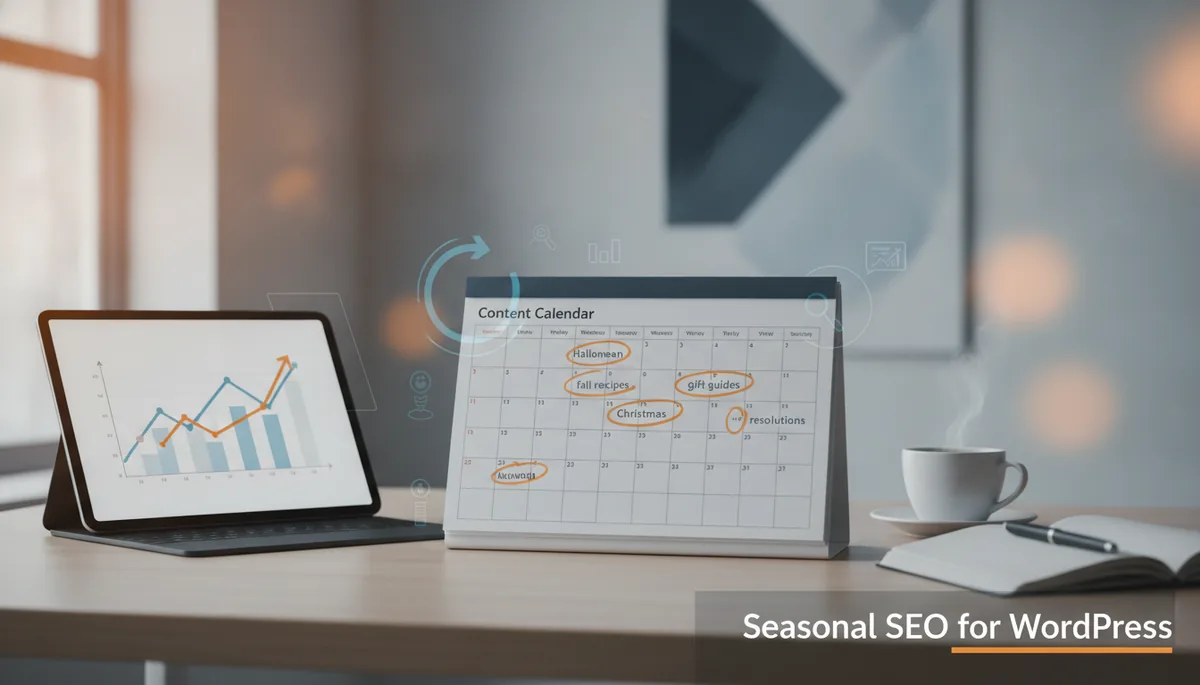
SEO isn’t a single sprint; it’s a disciplined relay race. Build a content calendar mapped to topics and keywords — pillar pages for big topics and cluster posts for specific queries. Every 6–12 months, audit older posts: update facts, refresh examples, fix broken links, and add internal links from newer, relevant posts. I keep a spreadsheet with dates, target keywords, and notes on what to update; it saves time and prevents me from rewriting a perfectly fine intro because of a sudden bout of perfectionism.
Track rankings, traffic, and CTR. If a page’s impressions rise but CTR is low, tweak the title and meta description first. If rankings slip, check for technical issues, thin content, or new competitors. For posts that are close to the first page, even small content expansions — a new FAQ, a comparison table, or a clearer how-to step — can tip them over into the top 10.
- Create a calendar mapping pillar topics to clusters and keywords.
- Quarterly audits: update content, refresh images, fix links, and re-optimize headings/meta.
- Monitor Search Console and analytics for drops and optimization opportunities.
- Use internal linking strategically to boost underperforming pages.
Think of content planning like gardening: plant deliberately, prune regularly, and give your top performers a little extra fertilizer (internal links and fresh content). If you want a simple checklist to run before publishing, follow the five-step post checklist I use: intent check, title/meta/url, content structure, images & schema, speed/mobile test — publish and promote.
Next step: pick one underperforming post today and run it through the checklist above. Update the title/meta, add one internal link from a high-traffic page, compress images, and schedule the refresh. Little, deliberate actions compound — and they’re way more effective than chasing the latest shiny SEO trick.